Pemurnian Debate 2026
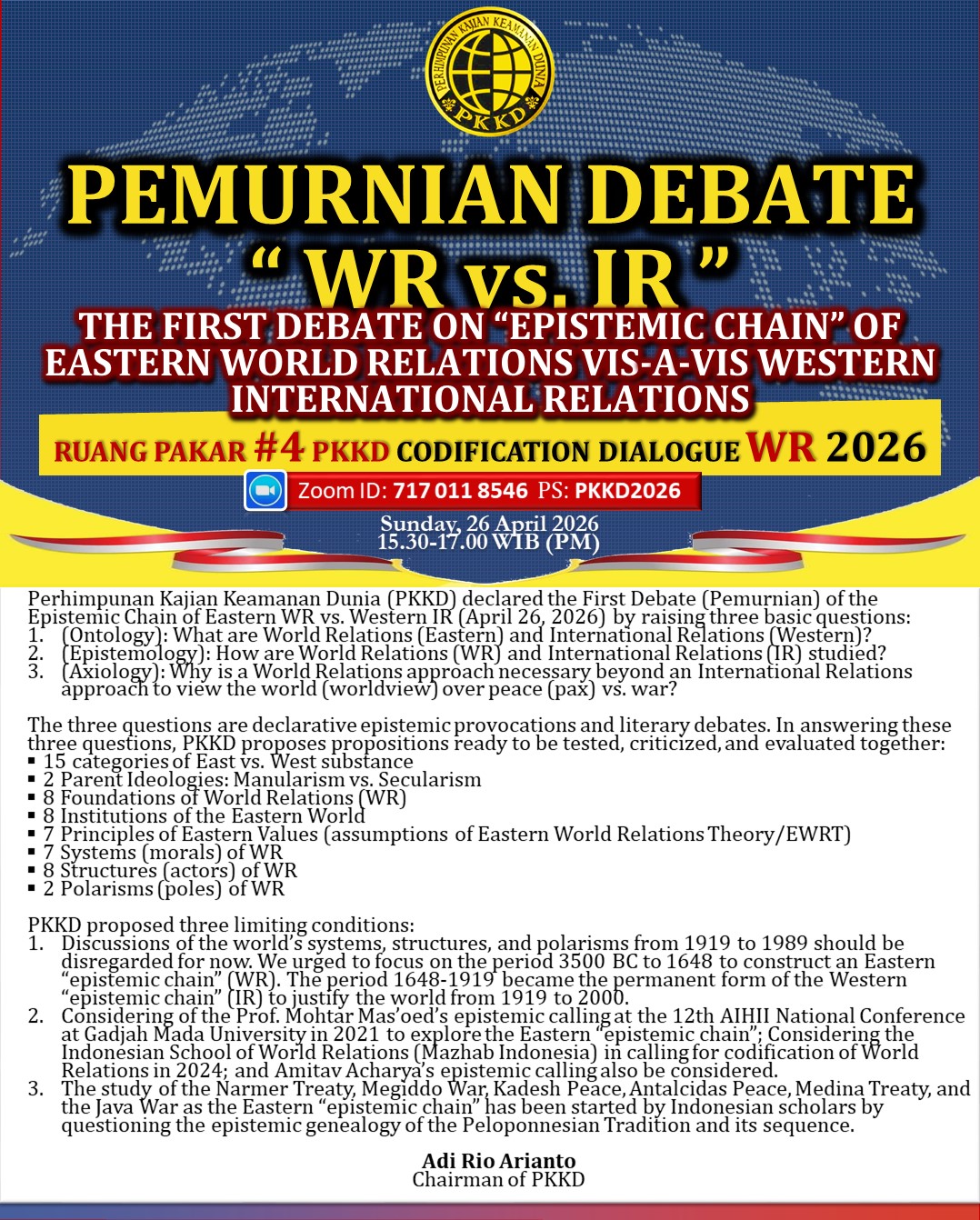
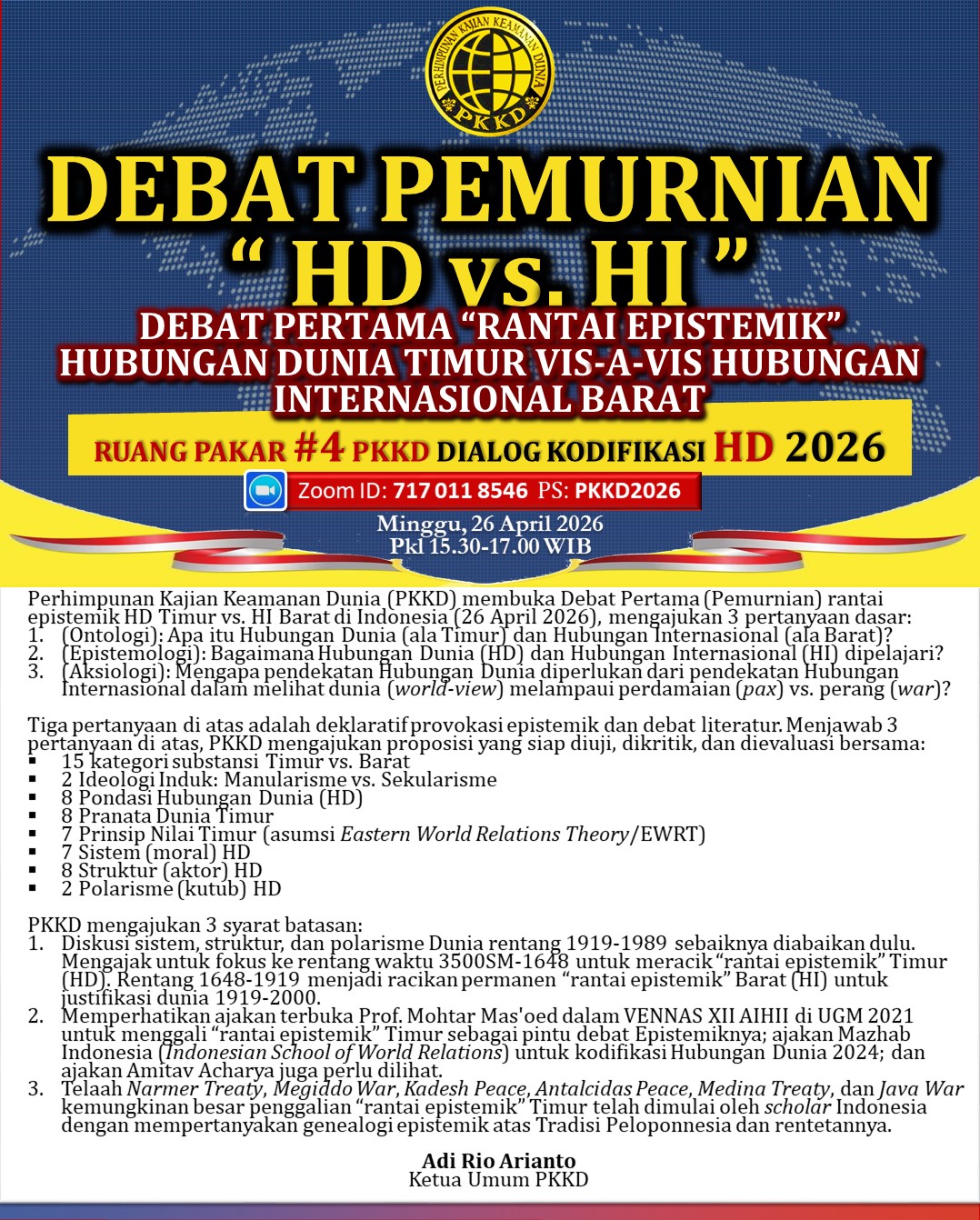
“PEMURNIAN DEBATE WR VS. IR: THE FIRST DEBATE ON EPISTEMIC CHAIN OF EASTERN WORLD RELATIONS VIS-A-VIS WESTERN INTERNATIONAL RELATIONS” (INDONESIA, 26 APRIL 2026)
Ruang Pakar Ke-4 Perhimpunan Kajian Keamanan Dunia (RP4-PKKD) has declared “PEMURNIAN DEBATE WR VS. IR: THE FIRST DEBATE ON EPISTEMIC CHAIN OF EASTERN WORLD RELATIONS VIS-A-VIS WESTERN INTERNATIONAL RELATIONS” on 26 April 2026 that was attended by 40 Indonesian Scholars as Declarators and 1 Initiator, namely Adi Rio Arianto, who also serves as the General Chairman of the PKKD and Founder of Mazhab Indonesia. The following are the names of the Declarators and Initiators (40+1) “Pemurnian Debate 2026″:
- Adi Rio Arianto, S.IP., M.A., CIQnR Universitas Pembangunan Nasional Veteran Jakarta arianto.adirio@gmail.com and arianto.adirio@upnvj.ac.id
- Prof. Ali Muhammad, S.IP., M.A., Ph.D. Universitas Muhammadiyah Yogyakarta ali.fisipol@gmail.com
- Alessandro Kurniawan Ulung, S.Sos., M.A. Universitas Satya Negara Indonesia a.kurniawan.ulung@usni.ac.id
- Dr. (Cand.) Agussalim Burhanuddin, S.IP., MIRAP. Universitas Hasanuddin agussalim.fisip@unhas.ac.id
- Andrea Abdul Rahman Azzqy, S.Kom; M.Si; M.Si (Han). Universitas Budi Luhur andrea.abdulrachman@budiluhur.ac.id
- Aria Aditya Setiawan, S.IP, M.Si. Universitas Cenderawasih Papua aria.adityas@gmail.com
- Mayor Aris Akbar Kementerian Pertahanan Republik Indonesia (Kemhan RI)
- Arthuur Jeverson Maya, S.Sos., M.A. Universitas Kristen Indonesia arthuur.jmaya@uki.ac.id
- Ayusia Sabhita Kusuma, S.IP., M.Soc.Sc. Universitas Jenderal Soedirman Universitas Jenderal Soedirman
- Broto Wardoyo, S.Sos., M.A., Ph.D. Universitas Indonesia itokwardoyo@gmail.com and broto09@ui.ac.id
- Firstyarinda Valentina Indraswari, S.IP., M.Si. Universitas Brawijaya firstyarinda@gmail.com
- Dr. Hendra Manurung, S.IP, M.A. Universitas Pertahanan hendra.manurung@idu.ac.id
- Dr. Husni Amriyanto Putra, S.IP., M.Si. Universitas Muhammadiyah Yogyakarta husniamriyanto@umy.ac.id
- Dr. Ian Montratama, S.E., M.E.B., M.Si. (Han). Universitas Pertamina ian.montratama@universitaspertamina.ac.id
- Ignatius Ismanto, S.Sos., M.Si. Universitas Pelita Harapan ignatius.ismanto@uph.edu
- Irawan Jati, S.IP., M.Hum., M.S.S., Ph.D. Universitas Islam Indonesia irawan.jati@uii.ac.id
- Ismah Rustam, S.IP., MA., Ph.D. Universitas Mataram ismah09@yahoo.com
- Dr. Jeanne Francoise, S.Hum., M.Si. (Han.) President University jeanne@president.ac.id
- Karina Putri Indrasari, B.A., M.A. Universitas Pelita Harapan karina.indrasari@uph.edu
- Lukman Fahmi Djarwono, S.IP., M.Si. Universitas Sebelas Maret lukman.f.d@staff.uns.ac.id
- Dr. Drs. Mohammad Saeri, M.Hum. Universitas Riau m.saeri@unri.ac.id
- Mely Noviryani, S.Sos., M.M., M.A. Universitas Brawijaya m.noviryani@ub.ac.id
- Mokhamad Luthfi, S.I.P., M.Si., Ph.D (Cand.) Universitas Al-Azhar Indonesia luthfi@uai.ac.id
- Drs. Muhadi Sugiono, M.A., Ph.D (Cand.) Universitas Gadjah Mada msugiono@ugm.ac.id
- Muhammad Abdurrohim, S.IP., LL.M., Ph.D (Cand.) Universitas Satya Negara Indonesia m.abdurrohim@usni.ac.id
- Muhammad Nizar Hidayat, S.IP., M.A. Universitas Mulawarman m.nizar.hidayat@gmail.com
- Muhammad Yamin, S.IP., M.Si Universitas Jenderal Soedirman) yamin.unsoed@gmail.com
- Nanda Avalist, S.IP., M.Si, Ph.D Universitas Al-Azhar Indonesia nanda.avalist@gmail.com
- Ni Komang Desy Setiawati Arya Pinatih, S.IP., M.Si. Universitas Brawijaya d.pinatih@ub.ac.id
- Pradono Budi Saputro, S.Hum., M.Si. Universitas Satya Negara Indonesia pradono.budi@usni.ac.id
- Ramdhan Muhaimin, S.Sos., M.Soc.Sc. Universitas Al-Azhar Indonesia alwhy83@gmail.com and ramdhan.muhaimin@uai.ac.id
- Dr. Rizal Aditya Hidayat Universitas Al-Azhar Indonesia rizal.aditya@uai.ac.id
- Robi Sugara, S.IP., M.Sc. Universitas Islam Negeri Syarif Hidayatullah Jakarta robi.sugara@uinjkt.ac.id
- Dr. Saiman Pakpahan, S.IP., M.Si. Universitas Riau
- Dr. Phil. Shiskha Prabawaningtyas, S.IP., MA Universitas Paramadina shiskha.p@gmail.com
- Dr. Sugeng Riyanto, S.IP., M.Si. Universitas Muhammadiyah Yogyakarta riyanto_sugeng@yahoo.com
- Syaiful Anam, S.IP., M.Sc., MIS. Universitas Mataram s.anam@unram.ac.id
- Tia Panca Rahmadhani, S.Hub.Int., M.I.Pol. Universitas Satya Negara Indonesia tiapancarahmadhani@gmail.com
- Uni W. Sagena, Ph.D Universitas Mulawarman unisku2@unmul.ac.id and unisku4@gmail.com
- Dr. Yusep Ginanjar, S.IP., M.Si Universitas Jenderal Achmad Yani yugin.ginanjar@yahoo.com.
- Zulkifli Harza, S.IP, M.Soc.Sc Universitas Andalas zharza@soc.unand.ac.id
The opening of the Pemurnian Debate 2026 will be the main gateway for codifying the epistemic chain of World Relations (WR), International Relations (IR), and World Security (WS) related to the paradigms, philosophies, theories, concepts, models, and patterns of original ideas from Indonesian scholars for the formation of the “Mazhab Indonesia” or “Indonesian School of World Relations“.
To achieve adequate codification of the epistemic chain with Indonesian characteristics, PKKD together with the Indonesian School continues to conduct targeted recruitment through the RP4-PKKD series by inviting scholars who have original ideas for the development of World Relations (WR), International Relations (IR), and World Security (WS).
These ideas were introduced by the PKKD and the Mazhab Indonesia (Indonesian School) on a rolling basis throughout 2026, until the codification for the formation of the “Indonesian School of World Relations.” The following are some key points related to the initial codification at the Opening of the Pemurnian Debate 2026:
- The Pemurnian Debate WR vs. IR became the codification of the Eastern vs. Western Epistemic Chain and become the gateway for the connection of the Indonesian Epistemic network with the other established epistemic network. The codification of the Pemurnian Debate was aimed at achieving the Indonesian Epistemic Network, namely the Indonesian School, by connecting it with other epistemic networks: the English School, the American School, the Copenhagen School, the Canadian School, the Russian School, the French School, the Frankfurt School, the Indian School, the Chinese School, and other schools.
- The Pemurnian Debate was opened by PKKD with an initial introduction of the study of the Roots of the Epistemic Chain of World Relations (Eastern World Relations Theory) vs. International Relations (Western Internastional Relations Theory), World Security (Fifth Base of World Security), Methodology, Historical Source Tracking (Resources Comparative), Comparison of 15 Basic Substances of Eastern WR vs. Western IR (consists of: 2 Parent Ideologies: Manularism vs. Secularism; 8 Foundations of World Relations (WR); 8 Institutions of the Eastern World; 7 Principles of Eastern Values (assumptions of Eastern World Relations Theory/EWRT); 7 Systems (moral) of WR; 8 Structures (actors) of WR; and 2 Polarisms (poles) of WR).
- The Pemurnian Debate 2026 ultimately adopted Manunggalism as the core thought of the “Mazhab Indonesia” (Indonesian School of World Relations), as well as a paradigm, philosophy, and theory (ontologically, epistemologically, and axiologically) supported by an explanation of the Principles of Manunggalism, the Basic Assumptions of Manunggalism, and its application in recent case studies and its comparison with established grand theories. At the Opening of the 2026 Pemurnian Debate, Manunggalism introduced several derivative theories (7+1 core thoughts) that has been published in several scientific journals, namely Eastern World Relations Theory, World Manularism Theory, Manunggal Peace Theory (“Manunggalistiwa”), Geometripolitika (Geometripolitization), Fifth Base World Security, World Geometrian War, and Manunggalization, also as well as theories that are in the process the making. All of these theories support the expansion of the Manunggalian Era (Pemurnian) that was introduced by the Indonesian School at the 1st Congress of the PKKD in 2022 and the 1st Congress of the Mazhab Indonesia in 2024.
- In maintaining the spirit of the Pemurnian Debate 2026, the RP4-PKKD series continued with the recruitment of Indonesian scholars who have original ideas on the development of the epistemic chain: World Relations (WR), International Relations (IR), and World Security (WS).
The following is the background to the birth of the idea “PEMURNIAN DEBATE WR VS. IR: THE FIRST DEBATE ON EPISTEMIC CHAIN OF EASTERN WORLD RELATIONS VIS-A-VIS WESTERN INTERNATIONAL RELATIONS” which is then known as the “Pemurnian Debate 2026”.
Knowledge about organizing the world has often been pursued in very complex ways, from ancient times to the present. From the ancient era to the new (modern) era. From ancient Asia to modern Europe. From ancient Africa to modern America. Even from ancient Eurasia to modern Australia. Social and Political Sciences, which are part of the Humanities, have many approaches to organizing the world, one of which is the discipline of “International Relations.” For centuries, since 1919, the discipline of International Relations has shaped the world based on Western values rooted in the traditions of Ancient Greece and Ancient Rome.
Not only that, the discipline of International Relations also offers a major paradigm in understanding the world order from a Western perspective, namely “International Relations” which is rooted in Western traditions that began to be adopted from the Peloponnesian War (431-404 BC) in Ancient Greece until rolling to the Peace of Westphalia (1648) in Europe. The most robust Western tradition and adopted to this day is the question of Liberal values rooted in materialism-secularism born in the Renaissance (Enlightenment) which was then used to build the world in the West (Atlantical) and exported on a large scale to the East (Manunggal).
What about the Eastern world? The Eastern world has lost its way for centuries since the Renaissance (Western Enlightenment) which resulted in the loss of the East’s relevance in that era. Therefore, after experiencing a long period of loss of relevance, the Eastern world began to find a way to be able to re-establish that relevance in the current century by offering a form of interaction and discipline of “World Relations” rooted in the traditions of Ancient Indonesia (Ancient Nusantara), Ancient Egypt, Ancient Mesopotamia, and Ancient Persia that spread to all continents of Asia, Africa, and Eurasia to form the Eastern tradition (Manunggal). In Ancient Indonesia, it began with the thoughts of Meganthropus paleojavanicus in the form of symbols that must be able to be deciphered by modern humans.
The Western world views world order through the discipline of International Relations, which focuses on the study of materialistic state interactions as international relations. Furthermore, the discipline of International Relations has produced various paradigms, philosophies, and theories about world organization through an accumulation of thought methods known as “Western International Relations Theory (WIRT).
Meanwhile, the Eastern World’s method of thinking in viewing the world order has not been well codified. Therefore, the Eastern World needs to introduce new ideas in the form of the “Discipline of World Relations” which focuses on the geometric interaction of “Tata Bawana (Fifth Base of World Security)” by presenting “Eastern World Relations Theory (EWRT)”. In an effort to present a balance of disciplines regarding how to organize the world, the Pemurnian Debate wants to offer a new method of thinking to understand the world order from the Eastern and compare it with the Western method of thinking in terms of viewing the world.
For centuries after the early Renaissance (Western Enlightenment), the Western (Atlantical) world has built a world peace system through a Liberal approach and shared it with the Eastern (Manunggal) world in a highly exploitative manner (Hobbes, 1642; Thucydides, 1972; Hegel, 2012; Herodotus, 2013; Darwin, 2017; Machiavelli, 2019). This occurs because the reproduction of knowledge in the Social Sciences, including International Relations (IR), creates hegemony (power over knowledge, both methods and goals) and epistemic inequality (Mas’oed, 1990; Dugin, 2009; Acarya and Buzan, 2010; Said, 2016; Arianto and Anggraini, 2023; Demak Declaration, 2024; Mas’oed, 2024).
Mochtar Mas’oed, in the 12th National Convention of the Indonesian International Relations Association (AIHII) 2021 at Gadjah Mada University, invited us to explore the epistemic chain in understanding the world with his very provocative epistemic statement that “Eropa menghasilkan pengetahuan berdasarkan pengalaman sejarahnya yang sangat parokial, sangat Eropa “Eurocentric” bahkan sangat “Anglo-Saxon”, tetapi itu diakui sebagai pengetahuan universal. Jadi, misalnya kita mempelajari Perang Diponegoro (Perang Jawa) maka yang dipakai adalah perang di Eropa…sehingga terjadilah proses penunggalan-penunggalan ontologi dan penunggalan epistemologi (Europe produces knowledge based on its historical experiences, which are very parochial, very “Eurocentric,” even very “Anglo-Saxon,” yet they are recognized as universal knowledge. So, for example, when we study the Diponegoro War (Java War), we use an analysis of the war in Europe…thus, a process of ontological singularity and epistemological singularity occurs)” (Mas’oed, 2021).
Amitav Acharya in his epistemic struggle expressed his admiration for Sukarno’s very revolutionary and provocative ideas regarding how the Indonesian leader saw the World Order which then encouraged various epistemic discussions in Asia until the discourse spread to the international level by stating that ”In the 1960s, Indonesia’s Sukarno expounded a radical conception of North-South conflict by arguing that the main division of the world was not through the Cold War, but through the struggle between the ‘Old Established Forces’ (OLDEFOS) and the ‘New Emerging Forces’ (NEFOS)” (Acharya, 2019).
Adi Rio Arianto in the 1st Indonesian School Congress in 2024 invited us to explore and then codify the Eastern epistemic chain with his very provocative epistemic statement challenging the established Western epistemic chain order that “Indonesia harus berani mendefinisikan ulang dunia abad ke-21 melalui penataan kembali dunia atas 8 (delapan) bagian yaitu sejarah, peradaban, budaya, tradisi, filsafat, ideologi, sosial, dan manusia. Inilah Era Pemurniaan. Dari sinilah, Deklarasi Demak 2024, Indonesia mengambil tanggung jawab membangun Perdamaian Manunggal (“Indonesia must boldly redefine the 21st-century world by restructuring a World Relations on eight parts: history, civilization, culture, tradition, philosophy, ideology, society, and humanity. This is the Era of Purification. From here, Demak Declaration 2024, Indonesia assumes the responsibility of building Manunggal Peace)” (Arianto, 2024).
A brief timeline of the achievement of the codification of the 2024 Demak Declaration based on the results of the 1st Indonesian School Congress on August 28 – September 28, 2024 with the main theme “Era Manunggalian: Menggerakkan Nilai-Nilai Keindonesiaan (Pemurnian) Untuk Mewujudkan Tata Dunia Baru Abad Ke-21” (The Era of Manunggalian: Mobilizing Indonesian Values (Pemurnian) to Establish a New World Order in the 21st Century). The 1st Indonesian School Congress was held in a series of four epistemic meetings, namely:
- The First Session codified “Ontologi Indonesia: Menggali Nilai-Nilai Keindonesiaan di Dalam Sejarah, Peradaban, Kebudayaan, Tradisi, Filsafat, Ideologi, Sosial, dan Manusia” (Indonesian Ontology: Exploring Indonesian Values in History, Civilization, Culture, Tradition, Philosophy, Ideology, Social, and Humanity) under the advice of R.P. Prof. Dr. Franz Magnis-Suseno SJ;
- The Second Session codified “Epistemologi Indonesia: Pemikiran Nilai-Nilai Keindonesiaan dalam Membangun Tata Dunia Baru Era Manunggalian Abad ke-21” (Indonesian Epistemology: Thinking about Indonesian Values in Building a New World Order in the 21st Century Era of Manunggalian) under the advice of Prof. Aleksius Jemadu, Ph.D;
- The Third Session codified “Aksiologi Indonesia: Perwujudan Nilai-Nilai Keindonesiaan dalam Tata Dunia Baru Era Manunggalian Abad Ke-21 (Hubungan Internasional Barat vis-a-vis Hubungan Dunia Timur)” (Indonesian Axiology: The Realization of Indonesian Values in the New World Order of the 21st Century Era of Manunggalian (Western International Relations vis-a-vis Eastern World Relations)) under the advice of Dr. Nanda Avalist, S.IP., M.Si; and
- The Fourth Session codified “Demak Declaration 2024” by the Founder and General Chairman of the Indonesian School (Mazhab Indonesia), Adi Rio Arianto, which contains eight foundations for the study of World Relations, namely: History, Civilization, Culture, Tradition, Philosophy, Ideology, Social, and Humans as World Institutions in forming interactions in the World Order of the Manunggalian Era.
There are Eight World Institutions contained in the Demak Declaration 2024 which has also been included in the epistemic publication at 10th International Conference on Nusantara Philosophy (ICNP UGM 2023) in the first article “Manunggalism: Paradigm, Philosophy, and Theory to View the World Relations (WR) Belong to Indonesian School (Mazhab Indonesia) in Manunggalian Era 21st Century” https://digitalpress.ugm.ac.id/article/433 namely:
- Ancient Indonesia/Ancient Nusantara, Ancient Egypt, Mesopotamia, and Persia are the founders and roots of the ideas of the Eastern World which spread across China, Russia, Indonesia (Nusantara), India, Iran, Mongolia, modern Egypt, Arabia, Turkey plus the unification of all nations on the continents of Asia, Africa, and Eurasia;
- In the World System there is a rotation of world leadership according to the world line-judge (hakim zaman) namely “Manunggalistiwa” is “a situation where the world order cycle goes hand in hand between the leading and led (Eastern world vs. Western world) following a straight line that is unbroken, dividing and connecting the ongoing power makes the eternal “Manunggal Peace” system (Teori Perdamaian Manunggal);
- ”World Relations System is Gotong Royong” which is a reference for world interactions in accordance with the basic Adimanusiawi (superhuman) values throughout the world, namely “Man is obedient creature (Manusia adalah makhluk yang taat or Manungso Niku Makhluk Sing Manut)” with barbarianism, communalism, and gotong royong;
- World Leader is world-nations leader who is entrusted with controlling the era as the Head of the World-nations according to the Leadership Quadrant by prioritizing core values Permusyawaratan in order to maintain the Eastern world vs. Western world;
- World War should be avoided, but it is allowed for the sake of world security and peace while maintaining world order, especially for the safety of children, women, the elderly, and humans who are not participating in the war, and the natural environment in accordance with core values of Geometrism;
- The essence of Geometricalism World-nations is to pursue, maintain and enhance “Haryamatra” (keagungan) namely “great prosperity in all regions of the world” in accordance with the values of Manunggality of the World: gotong royong (mutual cooperation), unity, and harmony;
- World Security is a pattern of security for the utilization of eight world dimensions (land, sea, air, underground, equator, vacuum, galaxy and cyberspace) according to the values Adibumi, World Institutions (Pranata Dunia), and spatial power order “Geometrism” according to Theory of Geometripolitik; and
- ”Adibumi Manunggal” is the World Government System in the Manunggal era throughout the world, and the duties of the Adibumiawan (wise adult men) and Adibumiawati (wise adult woman) is to disseminate the values of Manunggality of the World (Kemanungggaln Dunia) in accordance with “World Institutions” (Pranata Dunia) and Manupolitics.
The 1st Indonesian School Congress on August 28-September 28, 2024, which carries the main theme “The Era of Manunggalian: Mobilizing Indonesian Values (Purification) to Realize a New World Order in the 21st Century” (“Era Manunggalian: Menggerakkan Nilai-Nilai Keindonesiaan (Pemurnian) Untuk Mewujudkan Tata Dunia Baru Abad Ke-21”) has a strong connection with the 1st Congress of PKKD on November 20, 2022, which carries the main theme “World Security in the 21st Century: The Era of Pemurnian” (Keamanan Dunia Abad Ke-21: Era Pemurnian).
Both congresses contributed equally to the Manunggalian era. The 1st Congress of the PKKD was held under the advice of Broto Wardoyo, S.Sos., MA., Ph.D; Drs. Muhadi Sugiono, MA; Dr. Nanda Avalist , S.IP., M.Si; Dr. Sugeng Riyanto, M.Si; Dr. Ian Montratama, SE., MEB; Dr. Phil. Shiskha Prabawaningtyas, S.IP., MA.; and Pradono Budi Saputro, S.Hum., M.Si., and also included all input from 40 PKKD scholars during the 1st Congress of PKKD 2022.
Based on the above conditions, the PKKD has the opportunity to respond to the discourse of hegemony and epistemic inequality over Liberal Values. In this context, Eastern Values (Manunggal) become an alternative in analyzing the origins of human nature in Asia, Africa, and Eurasia. Efforts to present a balance of disciplines regarding how to organize the world, this framework offers a new method of thinking (paradigm, philosophy, and theory) to understand the world order from the East through the initiative of the Ruang Pakar ke-4 Perhimpuanan Kajian Keamanan Dunia (RP4-PKKD) by starting the codification “PEMURNIAN DEBATE WR VS. IR: THE FIRST DEBATE ON EPISTEMIC CHAIN OF EASTERN WORLD RELATIONS VIS-A-VIS WESTERN INTERNATIONAL RELATIONS”. The Pemurnian Debate was opened on April 26, 2026 in Indonesia by asking 3 basic epistemic questions as follows:
- The first question addresses its origins and ontological significance, namely: What are World Relations (Eastern) and International Relations (Western)? (Apa itu Hubungan Dunia (ala Timur) dan Hubungan Internasional (ala Barat)?)
- The second question examines the method of exploring and codifying its epistemic chain as an epistemological bridge, namely: How are World Relations (WR) and International Relations (IR) studied? (Bagaimana Hubungan Dunia (HD) dan Hubungan Internasional (HI) dipelajari?)
- The third question addresses its axiological purpose, namely: Why is WR approach necessary for IR approach in viewing the world (worldview) beyond peace (pax) versus war? (Mengapa pendekatan HD diperlukan dari pendekatan HI dalam melihat dunia (world-view) melampaui perdamaian (pax) vs. perang (war)?)
The three questions above are declarative epistemic provocations and literary debates. Therefore, PKKD proposes the following propositions: 15 Basic Substances of Eastern WR vs. Western IR (consists of: 2 Parent Ideologies: Manularism vs. Secularism; 8 Foundations of World Relations (WR); 8 Institutions of the Eastern World; 7 Principles of Eastern Values (assumptions of Eastern World Relations Theory/EWRT); 7 Systems (moral) of WR; 8 Structures (actors) of WR; and 2 Polarisms (poles) of WR).
In order to present the above proposition, PKKD proposes 3 limiting conditions, namely:
- Discussions of the world’s systems, structures, and polarisms from 1919 to 1989 should be disregarded for now. We urged to focus on the period 3500 BC to 1648 to construct an Eastern “epistemic chain” (WR). The period 1648-1919 became the permanent form of the Western “epistemic chain” (IR) to justify the world from 1919 to 2000.
- Considering of the Prof. Mohtar Mas’oed’s epistemic calling at the 12th AIHII National Conference at Gadjah Mada University in 2021 to explore the Eastern “epistemic chain”; Considering the Indonesian School of World Relations (Mazhab Indonesia) in calling for codification of World Relations in 2024; and Amitav Acharya’s epistemic calling also be considered.
- The study of the Narmer Treaty, Megiddo War, Kadesh Peace, Antalcidas Peace, Medina Treaty, and the Java War as the Eastern “epistemic chain” has been started by Indonesian scholars by questioning the epistemic genealogy of the Peloponnesian Tradition and its sequence
The entire process undertaken by RP4-PKKD in finding answers to the 3 questions above is called the “Pemurnian Debate” which strengthens the implementation of the “Manunggalian” Era since 2024. According to the results of the 1st PKKD Congress 2022, the PKKD Expert Room (RP-PKKD) is an epistemic discussion related to the development of scientific knowledge in World Security Studies and International Relations Studies to discuss in depth the building of the epistemic chain in terms of paradigms, philosophy, methodology, perspectives, theories, concepts, models, cases, phenomena, etc. RP4-PKKD presents special external and internal PKKD speakers attended by scholars and the general public in order to build a tradition of fair epistemic studies and debates from all levels of scholars including academics, civilians, and the military.
In opening the Pemurnian Debate, RP4-PKKD gave Adi Rio Arianto as the Initiator of the Pemurnian Debate to take the opportunity to present and explain in detail his epistemic views on World Relations. Adi Rio Arianto is the Founder of Mazhab Indonesia and the General Chairman of PKKD as well as the initiator of the Purification debate. Adi Rio Arianto presents his epistemic view as a way in which World Relations finds its relevance by balancing International Relations through tracing the epistemic chain by introducing 15 Basic Substances of Eastern WR vs. Western IR (consists of: 2 Parent Ideologies: Manularism vs. Secularism; 8 Foundations of World Relations (WR); 8 Institutions of the Eastern World; 7 Principles of Eastern Values (assumptions of Eastern World Relations Theory/EWRT); 7 Systems (moral) of WR; 8 Structures (actors) of WR; and 2 Polarisms (poles) of WR).
The Pemurnian Debate aims to answer the origins and ontological meaning of World Relations (WR) and International Relations (IR), how to explore and codify the epistemic epistemological chain of World Relations and International Relations, and to find the axiological goals that the WR approach requires from the IR approach in viewing the world (world-view) beyond peace (pax) vs. war.
The Pemurnian Debate seeks to delve into the existence and substance of all the philosophies of entirely the world (both Eastern and Western philosophies) through a combination of scientific science, historical exploration of ancient texts, and treatises on mysticism; critically analyze the current spirit of times around the world; as well as synthesizing paradigms, philosophies and theories for governance.
The Codification of the Pemurnian Debate is aimed at connecting the Indonesian Epistemic Network of the “Mazhab Indonesia” (Indonesian School of World Relations) with Epistemic Networks such as the English School, the American School, the Copenhagen School, the Canadian School, the Russian School, the French School, the Frankfurt School, the Indian School, the Chinese School, and other schools..
The codification of the Pemurnian Debate seeks to develop Eastern philosophical methods, strengthening the Eastern World Relations Theory (EWRT) based on Mysticism-Manualism, balancing the Western International Relations Theory (WIRT) based on Materialism-Secularism. The synthesis is the Discipline of World Relations as outlined in the work “Manunggalism: Paradigm, Philosophy, and Theory to View the World Relations (WR) Belong to Indonesian School (Mazhab Indonesia) in Manunggalian Era 21st Century.” https://digitalpress.ugm.ac.id/article/433
Indonesia, 26 April 2026
General Chairman of PKKD, Founder of Mazhab Indonesia, and Initiator of the Pemurnian Debate 2026 at the Ruang Pakar Ke-4 Perhimpunan Kajian Keamanan Dunia (RP4-PKKD)
Adi Rio Arianto