WR vs. IR Debate 2026
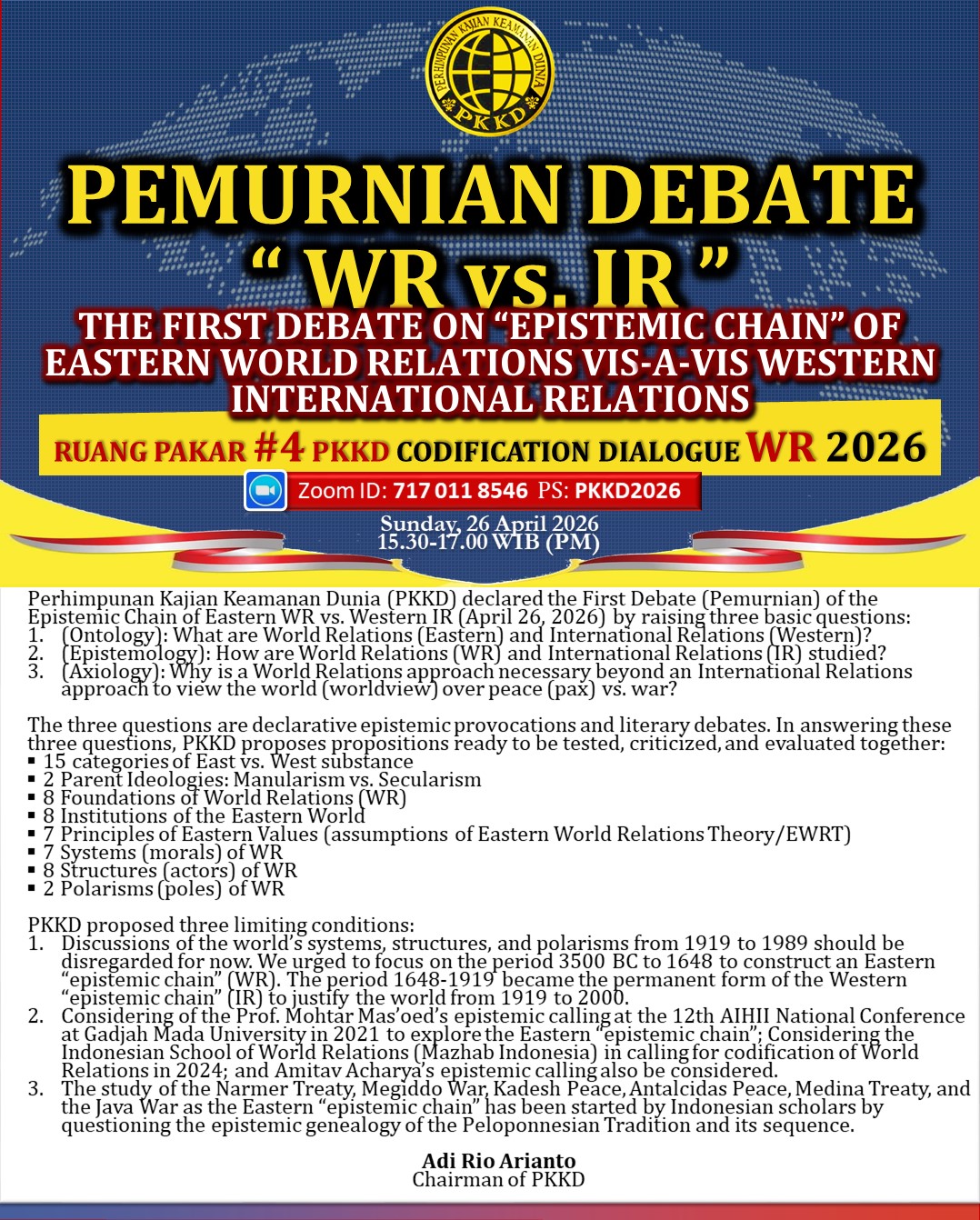
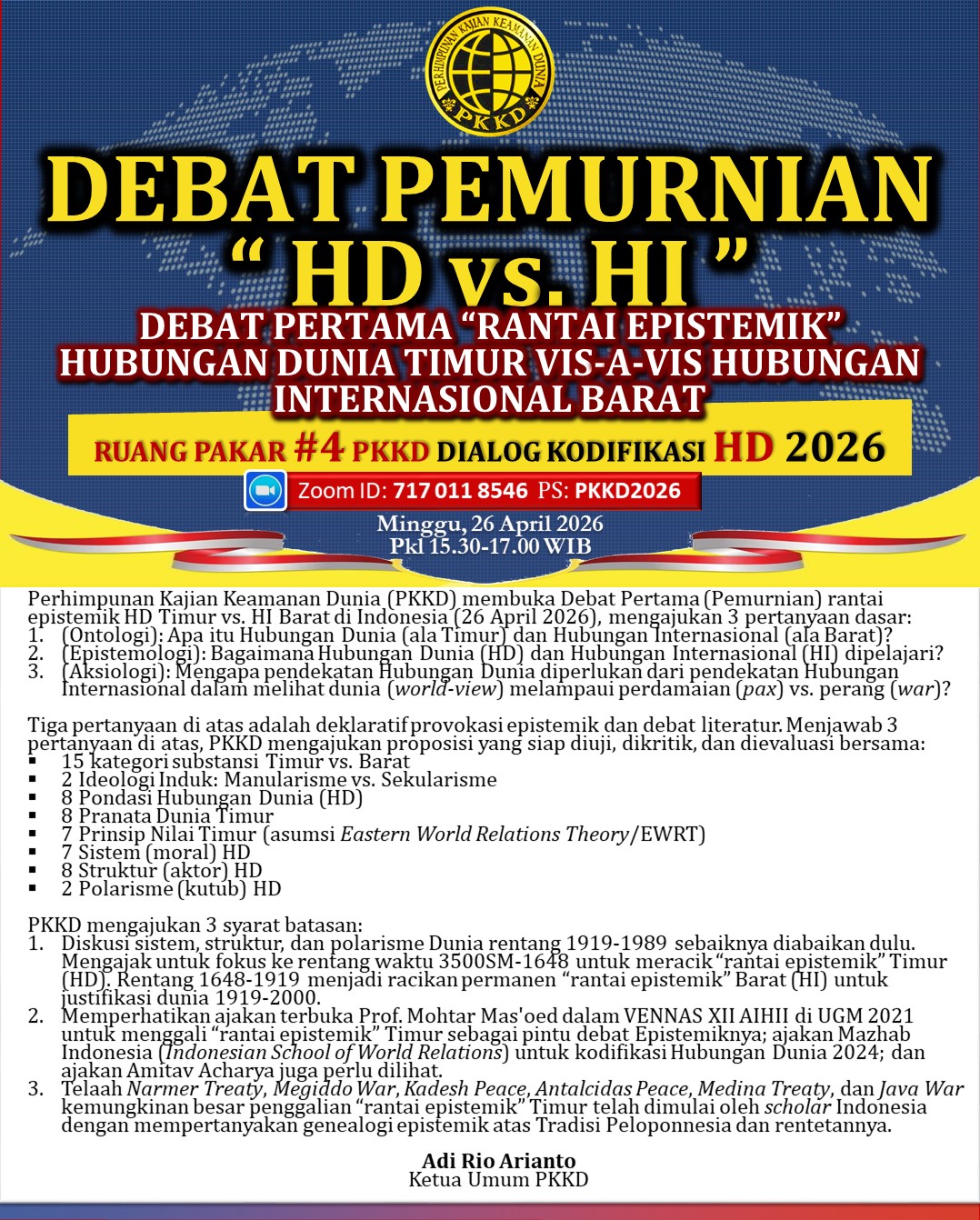
Debate on Eastern World Relations Theory (EWRT) vs. Western International Relations Theory (WIRT) also called as “Pemurnian Debate 2026” is a epistemic chain codification of World Relations (WR) against International Relations (IR) as a serial of debate in academical among the Indonesian scholars who concern about the development of how the Indonesian Scholars see the world (worldview) in many ways.
The serial of debate in the Pemurnian Debate 2026 among the Indonesian scholars has an opportunity to respond to the discourse of hegemony and epistemic inequality of the Western Values (Atlantical) concerning of the Discipline of International Relations (IR). In this context, the Eastern Values (Manunggal) become an alternative in analyzing the origins of human nature in Asia, Africa, and Eurasia by presenting the Discipline of World Relations (WR).
As an efforts to present a balance of disciplines regarding how to organize the world, the Indonesian Scholars offers a new method of thinking (paradigm, philosophy, and theory) to understand the world order from the East through the initiative of the Ruang Pakar ke-4 Perhimpuanan Kajian Keamanan Dunia (RP4-PKKD) by starting Pemurnian Debate 2026 in codifiying “PEMURNIAN DEBATE WR VS. IR: THE FIRST DEBATE ON EPISTEMIC CHAIN OF EASTERN WORLD RELATIONS VIS-A-VIS WESTERN INTERNATIONAL RELATIONS”.
The Pemurnian Debate was opened on April 26, 2026 in Indonesia and was attended by 40 Indonesian Scholars as Declarators and 1 Initiator (40+1). The Initiator is Adi Rio Arianto, who also serves as the General Chairman of the PKKD also as the Founder of Mazhab Indonesia. In the opening of the Pemurnian Debate, the Indonesian Scholars ask 3 basic epistemic questions as follows:
- The first question addresses its origins and ontological significance, namely: What are World Relations (Eastern) and International Relations (Western)? (Apa itu Hubungan Dunia (ala Timur) dan Hubungan Internasional (ala Barat)?)
- The second question examines the method of exploring and codifying its epistemic chain as an epistemological bridge, namely: How are World Relations (WR) and International Relations (IR) studied? (Bagaimana Hubungan Dunia (HD) dan Hubungan Internasional (HI) dipelajari?)
- The third question addresses its axiological purpose, namely: Why is WR approach necessary for IR approach in viewing the world (worldview) beyond peace (pax) versus war? (Mengapa pendekatan HD diperlukan dari pendekatan HI dalam melihat dunia (world-view) melampaui perdamaian (pax) vs. perang (war)?)
The three questions above are declarative epistemic provocations and literary debates. Therefore, the Indonesian Scholars proposes the following propositions: 15 Basic Substances of Eastern WR vs. Western IR (consists of: 2 Parent Ideologies: Manularism vs. Secularism; 8 Foundations of World Relations (WR); 8 Institutions of the Eastern World; 7 Principles of Eastern Values (assumptions of Eastern World Relations Theory/EWRT); 7 Systems (moral) of WR; 8 Structures (actors) of WR; and 2 Polarisms (poles) of WR).
In order to present the above proposition, the Indonesian Scholars proposes 3 limiting conditions, namely:
- Discussions of the world’s systems, structures, and polarisms from 1919 to 1989 should be disregarded for now. We urged to focus on the period 3500 BC to 1648 to construct an Eastern “epistemic chain” (WR). The period 1648-1919 became the permanent form of the Western “epistemic chain” (IR) to justify the world from 1919 to 2000.
- Considering of the Prof. Mohtar Mas’oed’s epistemic calling at the 12th AIHII National Conference at Gadjah Mada University in 2021 to explore the Eastern “epistemic chain”; Considering the Indonesian School of World Relations (Mazhab Indonesia) in calling for codification of World Relations in 2024; and Amitav Acharya’s epistemic calling also be considered.
- The study of the Narmer Treaty, Megiddo War, Kadesh Peace, Antalcidas Peace, Medina Treaty, and the Java War as the Eastern “epistemic chain” has been started by Indonesian scholars by questioning the epistemic genealogy of the Peloponnesian Tradition and its sequence
The entire process of “serial of debate” undertaken by RP4-PKKD in finding answers to the 3 questions above is called the “Pemurnian Debate 2026” which strengthens the implementation of the “Manunggalian” Era since 2024. According to the results of the 1st PKKD Congress 2022, the PKKD Expert Room (RP-PKKD) is an epistemic discussion related to the development of scientific knowledge in World Security Studies and International Relations Studies to discuss in depth the building of the epistemic chain in terms of paradigms, philosophy, methodology, perspectives, theories, concepts, models, cases, phenomena, etc. RP4-PKKD presents special external and internal PKKD speakers attended by scholars and the general public in order to build a tradition of fair epistemic studies and debates from all levels of scholars including academics, civilians, and the military.
In the opening of the Pemurnian Debate, RP4-PKKD gave Adi Rio Arianto as the Initiator of the Pemurnian Debate 2026 to take the opportunity to present and explain in detail his epistemic views on World Relations. Adi Rio Arianto is the Founder of Mazhab Indonesia and the General Chairman of PKKD as well as the initiator of the Purification debate. Adi Rio Arianto presents his epistemic view as a way in which World Relations finds its relevance by balancing International Relations through tracing the epistemic chain by introducing 15 Basic Substances of Eastern WR vs. Western IR (consists of: 2 Parent Ideologies: Manularism vs. Secularism; 8 Foundations of World Relations (WR); 8 Institutions of the Eastern World; 7 Principles of Eastern Values (assumptions of Eastern World Relations Theory/EWRT); 7 Systems (moral) of WR; 8 Structures (actors) of WR; and 2 Polarisms (poles) of WR).
The Pemurnian Debate 2026 ultimately adopted Manunggalism as the core thought of the “Mazhab Indonesia” (Indonesian School of World Relations), as well as a paradigm, philosophy, and theory (ontologically, epistemologically, and axiologically) supported by an explanation of the Principles of Manunggalism, the Basic Assumptions of Manunggalism, and its application in recent case studies and its comparison with established grand theories.
At the Opening of the 2026 Pemurnian Debate, Manunggalism introduced several derivative theories (7+1 core thoughts) that has been published in several scientific journals, namely Eastern World Relations Theory, World Manularism Theory, Manunggal Peace Theory (“Manunggalistiwa”), Geometripolitika (Geometripolitization), Fifth Base World Security, World Geometrian War, and Manunggalization, also as well as theories that are in the process the making. All of these theories support the expansion of the Manunggalian Era (Pemurnian) that was introduced by the Indonesian School at the 1st Congress of the PKKD in 2022 and the 1st Congress of the Mazhab Indonesia in 2024.
In this case the Mazhab Indonesia Manunggalism (Indonesian School of World Relations) come up as a New Grand Paradigm, Philosophy, and Theory in understanding a World Relations in Manunggalian Era. Manunggalism is a Grand Paradigm, Philosophy, and Theory in how to see the world order (worldview) in Manunggalian Era (Era Pemurnian) by using the “Gotong Royong as a World Relations System” belong to “Mazhab Indonesia Manunggalism (Indonesian School of World Relations) goes beyond the “Indonesian School of International Relations”. Manunggalism is the way of the Eastern world to see the world, and Manunggalistiwa has the position of being a world line-judge between the two world age forces: the Eastern world (Manunggal) and Western world (Atlantical).
The Pemurnian Debate 2026 is going to the reorganization of the world into 8 (eight) parts, namely history, civilization, culture, tradition, philosophy, ideology, social, and human nature system. So beside asking 3 basic epistemic questions, the “Mazhab Indonesia Manunggalism (Indonesian School of World Relations) also suggesting three questions as the consequences of follow-up questions to be debated among the scholars:
- What is the World Relations System that more suitable in understanding of the world relations today?
- What is the World Relations Structure that more suitable in understanding of the world relations today?
- What is the World Relations Polarism that more suitable in understanding of the world relations today?
To explore more, go to Pemurnian Debate 2026